Affordable and Resilient Housing for Sustainable Urban and Economic Development: A Comparative Policy Analysis of Saudi Vision 2030, the UN Sustainable Development Goals, and Pakistan’s National Housing Framework
DOI:
https://doi.org/10.63793/ISRE/0037Abstract
Background: More than 1.6 billion people around the world are living without safe and decent housing, which is one of the greatest challenges in the pursuit of sustainable urban development in the twenty first century.
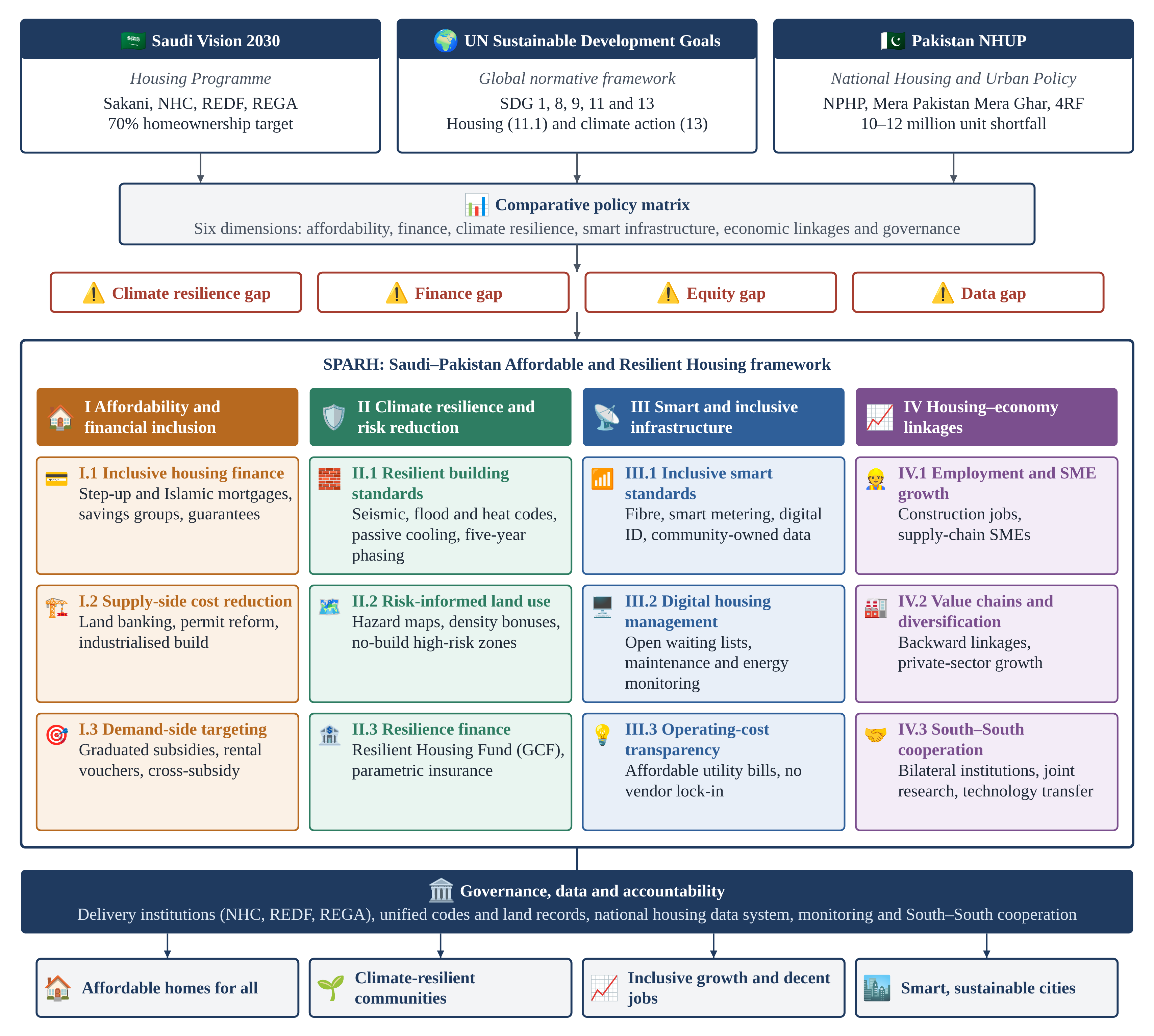
Objective: This paper aims to provide a policy comparison of three key policies, Vision 2030 housing agenda by Saudi Arabia, the United Nations Sustainable Development Goals (SDGs) relevant to housing and urbanisation (SDGs 1, 8, 9, 11 and 13) and the National Housing and Urbanisation Policy (NHUP) of Pakistan.
Methodology: The study identifies the critical convergences, structural gaps, and contextual divergences between these systems through a systematic document analysis, multi-criteria comparative matrices and structured case study review. It presents a novel conceptual framework called the Saudi-Pakistan Affordable and Resilient Housing Framework (SPARH), that incorporates four strategic elements: Housing affordability and financial inclusion, Climate resilience and Disaster risk reduction, Smart urban infrastructure, and Economic development linkages.
Results: Saudi Vision 2030 is particularly effective at institutional transformation and finance innovation, yet the Pakistan plan does not explicitly consider on-the-ground equity issues, and both plans fail to include planning and economic linkages between sectors and across sectors that incorporate climate resilience.
Conclusion: The SPARH policy framework provides a policy blueprint which can be transferred to other emerging economies that are facing rapid urbanisation, climate vulnerability and fiscal constraints. The paper ends with policy recommendations to advance the global agenda of affordable housing through bilateral cooperation, international financing mechanisms and governance innovations.
Downloads
Published
How to Cite
Issue
Section
License
Copyright (c) 2026 Talha Sabir

This work is licensed under a Creative Commons Attribution 4.0 International License.